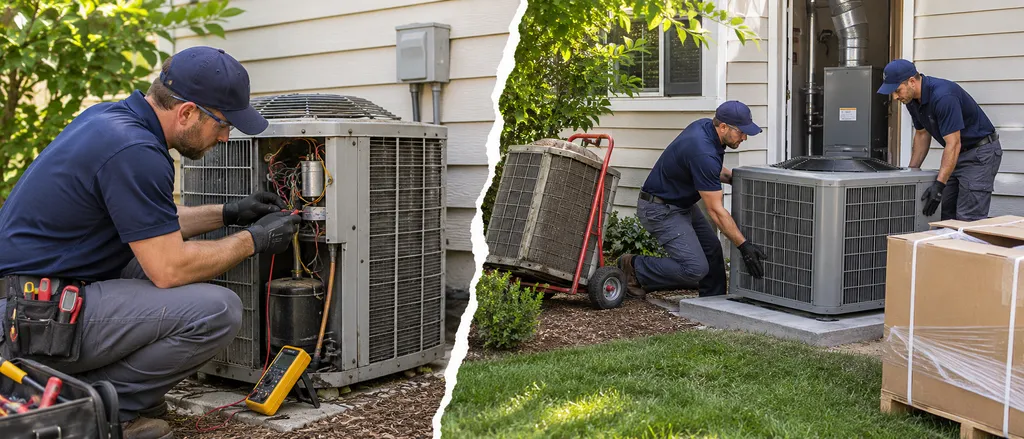
The Big Decision: Fix What You Have or Invest in Something New?
When your heating or cooling system stops working properly, one of the first questions that comes to mind is whether it's worth repairing or if it's finally time for a replacement.
It's a decision nearly every homeowner faces eventually. A new HVAC system can represent a significant investment, but repeatedly repairing an aging unit can become just as expensive over time.
The good news? You don't always need to replace your equipment just because something breaks.
Understanding the age, condition, efficiency, and repair history of your system can help you make a confident, financially sound decision.
1. When Repairing Your HVAC System Makes Sense
In many cases, a relatively inexpensive repair can extend the life of your heating and cooling equipment for several more years.
Consider repairing your system when:
Your equipment is relatively new. If your system is under 10 years old and has been properly maintained, repairing it is often the most economical option.
The problem is minor. Issues involving capacitors, contactors, thermostats, sensors, and some electrical components can often be resolved without replacing the entire system.
Repair costs are reasonable. If the repair is a small fraction of the price of replacement, keeping your existing equipment may be worthwhile.
Your system has been reliable. An isolated breakdown doesn't necessarily indicate that the entire system is failing.
Your energy bills remain consistent. If your system is heating and cooling effectively without unusually high operating costs, replacement may offer limited immediate savings.
Example: A $300 Repair on a Seven-Year-Old System
Imagine your air conditioner stops cooling during the summer. A technician identifies a failed capacitor and quotes $300 to replace it.
If the system is otherwise in good condition, spending several thousand dollars on replacement would probably be unnecessary.
A straightforward repair could provide years of additional service.
2. When Replacing Your HVAC System Is the Better Choice
There comes a point when continuing to repair older equipment becomes less practical.
Even if a technician can restore operation, the underlying system may be approaching the end of its useful life.
Consider replacing your system when:
Your equipment is approaching 15–20 years old. Many air conditioners and heat pumps warrant closer evaluation after roughly 10–15 years, while some furnaces can operate for 15–20 years or longer.
Repairs are becoming frequent. Multiple service calls in a short period can indicate that several components are nearing failure.
A major component has failed. Replacing a compressor, heat exchanger, or other costly component may not make financial sense on an aging system.
Energy bills continue increasing. Older equipment can lose efficiency, particularly when components deteriorate or maintenance has been neglected.
Your home experiences uneven temperatures. Persistent hot and cold spots, inadequate airflow, and poor humidity control may indicate broader performance or design problems.
Your equipment uses an older refrigerant. Systems using R-22 can be particularly expensive to service, making replacement worth evaluating.
Example: A $2,800 Repair on a 17-Year-Old Air Conditioner
Suppose your air conditioner is 17 years old, has required multiple repairs, and now needs a $2,800 compressor replacement.
Even if that repair restores cooling, the remaining components are still 17 years old.
Investing that money toward a newer, properly sized, more efficient system may be the smarter long-term decision.
3. Compare the Costs Before Making a Decision
There is no universal dollar amount that automatically makes replacement the better choice. However, comparing repair costs against replacement costs provides a useful starting point.
Repair cost compared with replacement
What to consider
Less than 15%
Repair is often reasonable if the system is otherwise healthy
15–30%
Consider the equipment's age, efficiency, and repair history
30–50%
Get a replacement estimate, especially for older equipment
More than 50%
Replacement deserves serious consideration
These percentages are guidelines, not fixed industry rules. A warranty-covered repair on a newer unit, for example, may make excellent financial sense even when the quoted repair would otherwise be expensive.
Also consider the cumulative cost of recent repairs rather than evaluating each bill individually.
4. Don't Overlook Energy Efficiency
One of the biggest advantages of replacing an outdated HVAC system is the opportunity to reduce operating costs.
Modern equipment may offer improved energy efficiency, variable-speed operation, better temperature regulation, and more sophisticated controls.
But higher efficiency doesn't automatically guarantee lower total ownership costs.
The actual savings depend on your climate, energy rates, current equipment efficiency, installation quality, and how often your heating and cooling system operates.
Before replacing a working system purely to save energy, ask for an estimate of annual operating savings and compare that against the total installed cost.
A qualified contractor should also evaluate proper equipment sizing rather than automatically installing the same capacity as your previous unit.
5. Warning Signs You Shouldn't Ignore
Not every HVAC problem requires replacement, but certain symptoms should prompt a professional inspection.
Unusual grinding, banging, or screeching noises
Repeated system shutdowns or tripped breakers
Weak airflow or significant temperature inconsistencies
Unexplained increases in utility bills
Water leaks or recurring ice buildup
Frequent cycling on and off
A persistent burning smell or other unusual odors
Important safety note: If you smell gas, leave the building immediately and contact your gas utility or emergency services from a safe location. A suspected cracked furnace heat exchanger or carbon monoxide issue should be evaluated promptly by a qualified professional; do not continue operating unsafe equipment.
6. Ask These Questions Before Approving a Major Repair
Before committing to an expensive repair or complete replacement, make sure your HVAC contractor can explain:
What exactly failed, and what caused the failure?
Is the problem isolated, or are other major components showing signs of deterioration?
How much will the repair cost, including labor and parts?
Are any components or repairs covered by a manufacturer's warranty?
What is the estimated remaining useful life of the equipment?
How much would a comparable replacement cost, fully installed?
What improvements in efficiency or comfort should I realistically expect?
A reputable HVAC professional should help you understand both choices rather than automatically recommending the most expensive solution.
7. Preventive Maintenance Can Delay Replacement
The most cost-effective HVAC replacement is often the one you don't need yet.
Routine maintenance can help identify developing problems before they become major failures and improve the chances of keeping your equipment operating efficiently.
Homeowners should prioritize changing or cleaning air filters as recommended, keeping outdoor units clear of debris, maintaining unobstructed vents, and scheduling appropriate professional service.
Regular inspections also help identify refrigerant leaks, electrical problems, drainage issues, and deteriorating components before they lead to more expensive damage.
Final Thoughts: Make the Decision Based on Value, Not Pressure
Replacing an HVAC system is not always necessary, and repairing older equipment is not always a waste of money.
The right choice depends on a combination of age, reliability, repair expenses, efficiency, comfort, and expected future operating costs.
A newer system with a minor problem usually deserves a repair. An aging system experiencing repeated failures may be ready for replacement.
The goal isn't simply to spend the least amount of money today. It's to make the decision that delivers the best comfort, reliability, and value over the years ahead.
Before approving a costly repair or replacement, request an itemized estimate and understand your options. A professional HVAC evaluation can help you avoid unnecessary expenses while keeping your home comfortable throughout the year.